Error code: %{errorCode}
Crocker-Donovan 2: Controversial fights that led to blockbuster rematches
Lewis Crocker and Paddy Donovan meet again this weekend, six months on from their controversial bout in March.
With Donovan seemingly on his way to a win over Crocker, he unleashed a punch after the bell - and was promptly disqualified.
Despite an appeal being rejected, the pair will meet again, live on DAZN, this Saturday. The stakes are even higher this time around, with the IBF welterweight world title on the line.
Anticipating a blockbuster, here are five previous fights that ended in controversy which produced enthralling rematches.
Froch-Groves
Billed as the ‘Battle of Britain’, Carl Froch and George Groves had formed a rivalry heading into their first meeting in November 2013.
Froch was offended that Groves had joined opponent Michael Kessler’s training camp as a sparring partner earlier that year.
This led to Froch labelling Groves a “traitor”, whilst also describing the younger fighter as ‘bitter and jealous’ and lacking ‘class’.
With the background set, all that was needed was for Groves to improve in the rankings to challenge for one of Froch’s two belts. Ultimately, it was a win over Noe Gonzalez Alcoba on the undercard of Froch’s victory over Kessler that catapulted Groves into title contention.

Throughout the build-up the tension was palpable, with refused handshakes and security getting involved at the weigh in. That energy transferred to the ring, with Groves starting strongly.
Towards the end of the first round, he knocked Froch down, clearly hurting the world champion. Froch managed to survive until the end of the round, but a trend had been set. Groves continued to put more pressure on, but was beginning to tire as the contest approached the final stages.
Whilst most controversial results stem from judges’ scorecards, the decision that caused public outcry stemmed from the referee.
Howard Foster was the man overseeing matters inside the ring, and when Groves stumbled backwards under a flurry of Froch punches in the ninth round, the referee quickly stepped in.
Many felt that was premature - with Groves launching a tirade inside the ring post-fight.
"It was a terrible, terrible, decision. At no point was I on shaky legs, my head was clear. The referee is supposed to stop the fight when you're in a dangerous position and can't protect yourself.
“If I'm making the guy miss and I'm still firing back that means I'm still conscious that I'm in the fight and that I'm doing the right things."
Whilst open to the idea of a rematch, Froch defended the referee’s decision.
The victorious Froch claimed: "Howard Foster did a fantastic job in stopping it and saving his career. George Groves turned his back on me and was slumping down to the floor, his arms were collapsed and his head was hanging and he wasn't defending himself. So I don't think the referee had any choice but to stop the fight."
A rematch was quickly arranged for the following year, the stakes increasing so much that there was little choice of venue other than Wembley Stadium. It was the first time boxing had been held at the home of football in almost 20 years; the first time a card was staged at the redeveloped stadium.
As Froch likes to remind fans, 80,000 watched on as he knocked out Groves in the eighth round, putting to bed any doubt of who was the better fighter.
Canelo-Golovkin
Canelo Alvarez’s trilogy of bouts with Gennady Golovkin was filled with controversy, but the first contest stands out for setting the tone. Even before there was any drama stemming from inside the ring, there were accusations that Canelo was ‘ducking’ Golovkin, after he vacated the WBC middleweight title shortly after defeating Amir Khan in 2016.
‘Triple G’ was instantly upgraded to the vacant title, and eventually the pair’s paths would cross in 2017. The WBA, WBC, and IBF titles were on the line, but there would be no new owner of the belts. That was because a tight fight arguably edged by the more active Golovkin was scored a split decision draw.
 (Getty Images)
Although many felt that a draw was not beyond the realms of possibility, questions were raised over how a judge could score the fight 118-110 in Canelo's favour.
Canelo’s subsequent suspension for failing a drugs test the following year both curtailed the rematch and added further intrigue and controversy to the rivalry. When the bout finally went ahead in late 2018, Canelo was given the nod following more judging controversy, with many feeling Golovkin had again deserved to win.
Mayweather-Castillo
After competing at super featherweight for the majority of his early career, Floyd Mayweather vacated his WBC strap to compete for the same title at 130lbs. Jose Luis Castillo held that specific title at lightweight, which made him a target for Mayweather.
A 5-1 favourite for the contest, Mayweather was in cruise control from the first bell as Castillo struggled to get inside and impact his opponent, who was making good on his credentials as a top pound-for-pound fighter. But the Mexican stepped the aggression up from the sixth round onwards, putting pressure on Mayweather.
Each fighter was deducted a point, Castillo for hitting on the break in the eighth, Mayweather for using his elbows in the 10th. Castillo outlanded his challenger, and many felt he may have pulled off the upset at the final bell.
 Harry How/Getty Images
However, they would have been bemused at how widely Mayweather took the decision, with two scores of 115-111 and a third of 116-111. Bob Arum described the scoring as ‘ludicrous’ and immediately set about organising a rematch.
By the time of the rematch, Mayweather was the A-side, largely due to taking the title off Castillo. Eyebrows were raised during fight week when Mayweather refused to attend the final press conferences promoting the fight, leading to promoter Arum demoting the bout to undercard status, pushing Wladimir Klitschko’s fight over Jameel McCline to the headlining act.
Castillo remained aggressive, but found Mayweather far more elusive and defensive. Mayweather was also more consistent, remaining strong in the latter rounds, with Castillo forced to miss multiple times.
Another unanimous decision went Mayweather’s way - but it was far tighter than the initial bout, with two judges scoring it 115-113, and a third slightly wider at 116-113.
- Read next | Floyd Mayweather's chaotic exhibition career and what it could mean for Mike Tyson clash
Pacquiao-Marquez
Another long series of fights marked with multiple controversies, Manny Pacquiao and Juan Manuel Marquez would share the ring four times across eight years.
Despite Marquez being knocked down three times in the opening round of their first meeting, it was believed that the Mexican had done enough to at least merit the draw eventually shared, although one judge did not give the customary 10-6 to Pacquiao in the opening round, instead scoring it at 10-7.
The second fight saw Pacquiao take a split decision over Marquez four years later, with Mexican fans again feeling like their man was hard done by. There would be another gap until the third installment of what eventually proved to be a tetralogy.
 Al Bello/Getty Images
Titled the 25th round, Pacquiao and Marquez would go the distance yet again. In another tight fight, Pacquiao took a majority decision - which led to loud boos from the crowd, who also tossed drinks and food towards the ring.
Reaction from the press was mixed, with different outlets scoring it completely different ways. Rather than wait years for another fight, the fourth - and final - bout was staged the following year.
This time the answer was definitive. In the dying embers of the sixth, Marquez unfurled a right hand straight into the face of Pacquiao. Sickeningly, the Filipino’s head snapped back before he fell to the canvas. So evident was the knockout, no count was necessary. Marquez had finally beaten Pacquiao at the fourth attempt.
Lewis-Holyfield
Just as all the marbles will be on the line this weekend when Canelo Alvarez takes on Terence Crawford, Lennox Lewis faced Evander Holyfield for undisputed status back in 1999.
At the time boxing was still in the three-belt era, with only the WBA, WBC, and IBF recognised as sanctioning bodies with ‘proper’ world titles. Still, being able to claim top-dog status in the heavyweight division will always be highly coveted in the sweet science.
Lewis will believe his reign as undisputed heavyweight champion should have started a bit earlier, with his first bout against Holyfield ending in controversy.
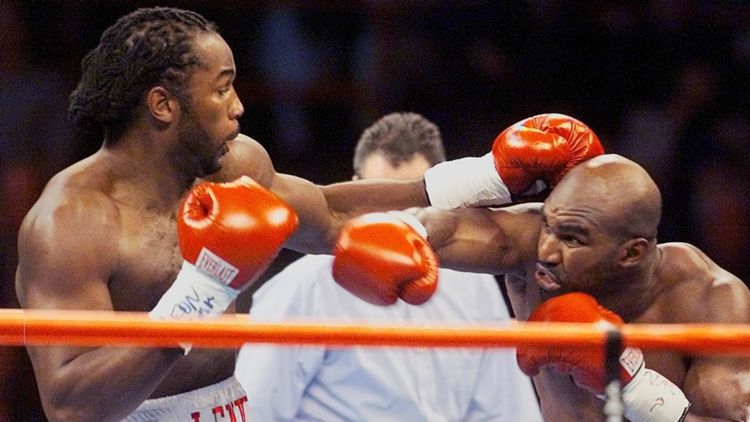 (Getty Images)
The Brit started the contest brightly before Holyfield showed signs of life in round three. But quickly the tide turned again, Lewis taking the fourth and fifth stanzas. In fact, it looked like Lewis was taking the clear majority of rounds as the fight reached its conclusion.
When the scores were read out, most watching would have expected Lewis to be declared the new undisputed heavyweight champion of the world, only to be left shocked by the scorecards.
A controversial split decision draw was derided by the HBO commentary and print media, with judges Eugenia Williams and Larry O'Connell subsequently admitting that they had made a mistake.
Not only was there a sense of injustice, but the heavyweight division was still missing a true king. The sanctioning bodies agreed, immediately ordering a rematch. Eight months later, a similar performance from Lewis was recognised by the scorecards as time he took a unanimous decision and all three belts back to Britain.
Watch the biggest fights and best fighters with a DAZN subscription
A DAZN subscription provides access to over 185 fights a year across a range of combat sports from the world's best promoters.


