Error code: %{errorCode}
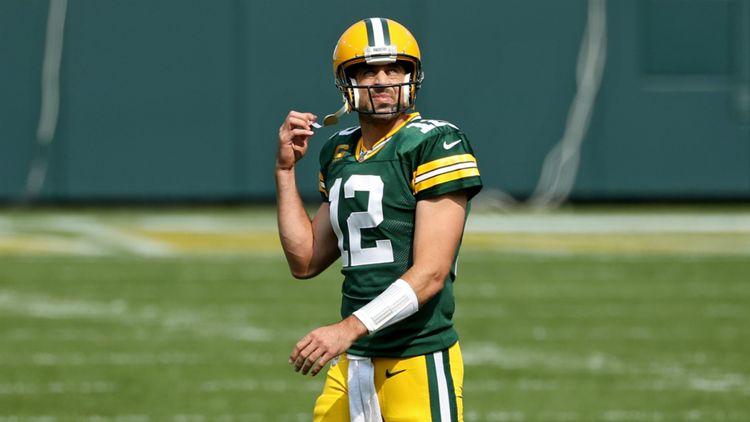
NFL Icons: Aaron Rodgers, the surgical gunslinger
Aaron Rodgers emerged in the midst of a celebrated generation of NFL quarterbacks and in the shadow of an all-time great. Yet the Golden State kid with the gilded arm bided his time before proving himself to be the measure of his peers and his predecessor to establish his own legacy of greatness.
From the anguish of a draft-night slide to the euphoria of hoisting the Lombardi Trophy and earning four league MVPs, Rodgers’ career began with a fall but has been characterised by a meteoric rise.
His path to NFL stardom wasn’t supposed to have been as winding as it turned out. As he sat in the green room at the 2005 NFL draft, he was expected to be one of the first names off the board – perhaps even the first, meaning he’d join the team he’d followed since childhood, the San Francisco 49ers.
But instead of a predestined Hollywood-style dream entry into the professional ranks, fate conspired against Rodgers.
“It was the longest day of my life,” Rodgers later admitted of his draft night slide. “But it made me who I am.”
The quarterback who’d shone in two collegiate seasons with Cal was overlooked in favour of Alex Smith when the Niners were on the clock with the first overall pick. Rodgers instead fell all the way to pick No.24, and to a team who had no need for a quarterback.
The Green Bay Packers already had Brett Favre, a Super Bowl champion and three-time MVP who, at age 35, was not ready to hand over his starting spot to a rookie.
For three seasons, Rodgers stood – or, rather, sat – in the shadow of Favre, studying behind one of the NFL’s most iconic quarterbacks. It was a masterclass in patience, perseverance, and preparation.
 (Getty Images)
The relationship between Rodgers and Favre was famously distant. Favre once quipped, “My contract doesn’t say I have to get Aaron Rodgers ready to play. Now, hopefully, he watches me and gets something from that.”
Rodgers absorbed the lessons that only time could teach: poise under pressure, command of the huddle and, most critically, how to lead.
In 2008, after months of speculation and a brief Favre retirement saga, the Packers turned the keys over to Rodgers. The response was polarized and the task the now 25-year-old quarterback faced was mammoth – how could anyone follow Favre?
Rodgers answered emphatically. In his first season as a starter, he threw for over 4,000 yards and 28 touchdowns. Within three years, he’d etched his name among the greats of the famous old franchise.
That’s because in 2010 he led the Packers to their fourth Super Bowl triumph and first since Favre has lifted the Lombardi 14 years earlier. Rodgers earned the Super Bowl MVP award with a 304-yard, three-touchdown performance in a 31-25 victory over the Pittsburgh Steelers.
And although Rodgers would never reach the Super Bowl again, he quickly went on to prove that the excellence – the accuracy, the daring, the inventiveness – that had seen him fire Green Bay to glory was no flash in the pan
He won his first NFL MVP in 2011, leading the Packers to a 15-1 record while throwing 45 touchdowns to just six interceptions. Statistically, it was one of the greatest quarterback seasons in NFL history, as he posted a then-record 122.5 passer rating.
 (Getty Images)
Another three MVP awards followed in 2014, 2020, and 2021, leaving him just one shy of Peyton Manning’s all-time record for NFL’s most prestigious individual accolade.
In 2020, at age 37, he posted a career-high 48 touchdown passes and led the league in completion percentage and passer rating, reminding everyone of his ageless brilliance.
He’d entered the league in an era marked out by outstanding quarterback play, highlighted by the likes of Tom Brady, Drew Brees, Manning and Favre. More than a decade later, he was showing the new generation of Patrick Mahomes, Josh Allen, Lamar Jackson and co. how it’s done.
Rodgers’ statistical résumé makes for astonishing reading. He ranks top 10 all time in almost every major category and boasts the best-ever career passer rating (105.6) among qualifying quarterbacks. He also has the lowest career interception percentage in NFL history.
But what made Rodgers special cannot truly be quantified; it can only be observed at marvelled at – the lightning-quick release, the effortless power, the guile and inventiveness, the accuracy and timing. In terms of pure talent, he is one of one.
 Rich Schultz/Getty Images
In 2023, Rodgers stunned the football world by leaving Green Bay for the New York Jets. The move was seismic – part Brady-to-Tampa, part Montana-to-Kansas City.
Expectations soared, but the Jets failed to take off.
In the season opener, Rodgers tore his Achilles just four plays into the game. He returned to the field in 2024 at age 40. He showed flashes off his trademark gifts en route to a respectable 28 touchdowns and just 11 interceptions, but the Jets slumped to a 5-11 record and his services were not retained.
Aaron Rodgers’ career was never linear. It was cinematic. He arrived late, rose gradually, and endured everything—doubt, injury, change, expectation.
“I’m in my 20th year, Rodgers said last season. “I’ve figured out a way to do this for a long time, so just got to remember why you fell in love with this game.”
That quote hangs heavily over his future plans, as he ponders whether to hang up his cleats after leaving the Jets or to join the Steelers, the team he ousted in his Super Bowl win a decade and a half ago and who now covet his talents.
But irrespective of whether he still has enough love for the game to keep playing at age 41, Rodgers has already provided one of the most unforgettable careers in NFL history.
Here are three classic Aaron Rodgers performances you can relive now via GamePass on DAZN:
Vs Oakland Raiders, 20 October 2019 – 429 yards, five touchdowns
Vs Carolina Panthers, 19 October 2014 – 255 yards, three touchdowns
@ Chicago Bears, 28 September 2014 – 302 yards, four touchdowns
More NFL
- Who are the starting quarterbacks for all 32 NFL franchises?
- NFL London 2025: Schedule, which teams are playing and host stadiums
- NFL all-time greatest quarterback
- Buy NFL Game Pass
- The most unbelievable play in Super Bowl history
- Which NFL team has the most Super Bowl wins?
- The best Super Bowl halftime shows of all time


