Error code: %{errorCode}
Calzaghe-Froch, Haye-Fury: The all-British grudge matches that never happened
Boxing fans love a domestic dust-up. With pride and bragging rights on the line, fighters seem to dig deeper than ever to get their hand raised and this often leads to gripping encounters.
We have been hoping to get the biggest all-British fight of the lot for the past decade between Anthony Joshua and Tyson Fury, but it still hasn’t materialised.
Joshua called out Fury earlier this month, raising hopes that the heavyweight clash could finally be made, only for his trainer Ben Davison to admit things are “not looking too promising” right now.
If Joshua-Fury does not happen, it would not be the first grudge match to fall through.
Let’s look back at some of the biggest all-British fights that somehow slipped by the wayside.
 Mark Robinson/Matchroom Boxing
Ricky Hatton vs Junior Witter
Ricky Hatton and Junior Witter both turned professional in 1997, but it was the latter who moved onto the world stage first.
Witter got a shot at IBF super lightweight champion Zab Judah in June 2000 but slipped to a points defeat.
He worked his way back into the title mix over the coming years and by the mid-2000s, Witter and Hatton were both gunning for a 140lb belt.
Hatton reached the top of the mountain first by beating pound-for-pound star Kostya Tszyu in his hometown of Manchester.
A year later, Witter joined him as a world champion when he outpointed former Floyd Mayweather opponent, DeMarcus Corley, in London.
The stage appeared to be set for Hatton and Witter to face each other in a unification clash. Witter tried to goad his rival into signing the contract, but there were concerns about Witter’s switch-hitting style not being crowd-friendly and Hatton decided he had bigger fish to fry as he chased a mega-fight with Mayweather.
He got his wish in December 2007 and had the backing of 20,000 Brits in Las Vegas but fell short against the American superstar.
Just five months later, Witter lost his title to Timothy Bradley, and he would never be champion again.
Hatton came back down to super lightweight after his Mayweather loss, only to be knocked out by Manny Pacquiao inside two rounds.
He subsequently took a lengthy break from the sport and the opportunity to face Witter had gone.
 Alex Livesey/Getty Images
Joe Calzaghe vs Carl Froch
Just as Hatton and Witter’s rivalry started to simmer, another feud began to brew in the super middleweight division.
Joe Calzaghe had first been crowned world champion in 1997 when he beat Chris Eubank and he defended his title for a decade.
He finally got the unification fights he craved in 2006 and 2007 as he dispatched the likes of Jeff Lacy and Mikkel Kessler to prove he was the man at 168lbs.
But fellow Brit, Carl Froch, was on the rise himself. Froch had swept aside his opponents on the domestic scene and wanted to get his hands on Calzaghe heading into 2008.
But the Welsh wizard knew he was in the twilight of his career and opted to target the biggest names in the sport instead.
In April 2008, he jumped up to light heavyweight to challenge Bernard Hopkins in Las Vegas for The Ring title and got the nod via split decision.
He decided to stay at 175lbs for one final fight against the legendary Roy Jones Jr at Madison Square Garden and won a lopsided decision before retiring with a perfect 46-0 record.
Froch was disappointed at missing out on the chance to take on Calzaghe, but did get to fight for the WBC super middleweight title that the Welshman had vacated just four weeks after the Jones Jr bout.
Froch beat Canada’s Jean Pascal in a thrilling battle in his hometown of Nottingham and went on to become a three-time world champion before hanging up his gloves in 2014.
 John Gichigi/Getty Images
David Haye vs Tyson Fury
Britain struggled to produce an elite heavyweight in the immediate aftermath of Lennox Lewis’s retirement. Then David Haye came along.
‘The Hayemaker’ had proved himself down at cruiserweight, travelling over to France to dethrone Jean-Marc Mormeck before destroying Enzo Maccarinelli in their unification bout.
A move up to heavyweight was inevitable and Haye pulled off the seemingly impossible when he defeated Nikolai Valuev in Germany, despite giving up seven stones in weight and almost a foot in height to the Russian.
Haye made two title defences before challenging the mighty Wladimir Klitschko. In an underwhelming affair, Klitschko dominated behind his jab to win on points and Haye looked set to enter retirement.
However, he was tempted back to the ring after engaging in a press conference brawl with Derek Chisora. The two men settled their differences in the ring, with Haye knocking out his rival in the fifth round, before another domestic foe arrived on the scene.
Tyson Fury had been working his way up the rankings and wanted to test himself against Haye in 2013.
The fight was made and it was hard to pick a winner. Would Haye’s experience prove too much or was this a changing of the guard moment?
In the end, we never found out the answer. After a lively launch press conference and an entertaining appearance on Sky Sports’ Ringside show, the fight was postponed when Haye suffered a nasty cut in sparring.
A new date was arranged, but Haye had to pull out again after reporting a shoulder injury that required surgery.
It would be over two years before Haye returned to the ring, while Fury went his own route to topple the younger Klitschko brother as he became the unified heavyweight champion in 2015.
 Getty Images
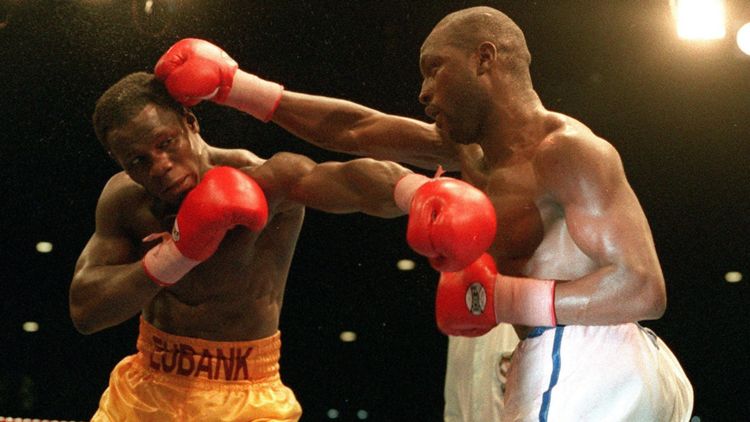
Chris Eubank vs Nigel Benn 3
Chris Eubank and Nigel Benn shared arguably the biggest rivalry in British boxing history in the early 1990s.
The pair famously signed the contracts on national television for their first fight in November 1990 as Eubank tried to get under his rival’s skin.
It was evident the two men did not like each other and that led to an epic back-and-forth contest.
Benn had Eubank hurt on multiple occasions and even scored a flash knockdown, but Eubank refused to be denied.
He came on strong in the ninth round, forcing the referee to jump in as he snatched Benn’s WBO middleweight title away from him.
A rematch simply had to happen, and it was arranged for October 1993 at Old Trafford. This time the WBO and WBC super middleweight titles were on the line.
The second fight did not quite have the same drama as the first, but it was still a thrilling battle with neither man taking a backwards step.
At the end of 12 rounds, it appeared Benn had done enough to win, but the fight was scored a split draw.
A trilogy bout seemed the next logical step for Eubank and Benn but the two men went their separate ways.
After making six more successful defences of his WBO strap, Eubank was beaten by Steve Collins and he never regained his title.
Benn held onto his own belt for a little longer before losing to Thulani Malinga in March 1996. Two further defeats by Collins led to his retirement later that year, and we never got to see how a third fight with Eubank would have played out.
The family rivalry has been renewed in 2025, with Chris Eubank Jr beating Conor Benn on points in a fight of the year contender in April.
A rematch is scheduled to take place on November 15, live on DAZN.
 Getty Images
The middleweight near-misses
At the start of the 2010s, Britain had three middleweights vying for world honours – Matthew Macklin, Darren Barker and Martin Murray.
Throw Ireland’s Andy Lee into the mix and the domestic scene was stacked at 160lbs.
The four men appeared to be on a collision course, but they each wanted to get a world title first.
Macklin got the first opportunity as he travelled over to Germany to take on WBA champion, Felix Sturm, in June 2011. After a closely fought encounter, Sturm got the nod via split decision.
In the same year, Barker faced The Ring champion Sergio Martinez and was stopped in the 11th round, while Murray also got his shot at Sturm but could only manage a draw as he fell just short of taking home championship gold.
Moving into 2012, Macklin and Lee had further chances to win a world title, but they were beaten by Martinez and Julio Cesar Chavez Jr, respectively.
The following year, a middleweight special version of The Gloves Are Off was recorded on Sky Sports, with all four men sat around the same table.
It seemed they were gearing up to face each other and the chances of a domestic clash increased when Barker finally became champion in August 2013 after he edged past Australia’s Daniel Geale.
However, his body let him down and he had just one more fight, losing to Sturm, before retiring with a hip injury.
Lee would also get his hands on a belt in 2014 when he knocked out Matt Korobov in Las Vegas, but his reign only lasted a year before he was defeated by Billy Joe Saunders.
Macklin and Murray never got their crowning moment or the chance to test themselves against their domestic rivals.
Watch James DeGale vs Matt Floyd live on DAZN
BKFC 81 sees Olympic boxing champion James DeGale make his Bare Knuckle debut. Watch the fight and whole fight card live with a DAZN subscription.
Annual and monthly options available, click here for pricing and options.


