Error code: %{errorCode}
I watched Usyk-Dubois from ringside and felt the air hum in a different frequency
In August 2023, Pete Carvill was ringside in Wroclaw to write his book Death of a Boxer, which was later named a ‘Sports Book of the Year’ by the Daily Mail and the Irish Times. The story below is an extract from that book.
It was two days after the Ukrainian Day of Independence, and the path to Wrocław Stadium was garlanded in yellow and blue.
Draw a line from the border Poland shares with Germany to the one it shares with Ukraine. Wrocław is about two-thirds of the way along that. The city was the third-largest in Poland after Warsaw and Krakow, but its population had risen from 673,000 to over 900,000 after Russia’s began its war against Ukraine. A quarter of a million Ukrainians were making their home there in 2023.
- Read next | Usyk vs Dubois 2: How to watch on DAZN
It had been a hot day, and the incoming night had done little to lessen the heat. The temperature had dipped weeks before and when everyone felt that the season was over and autumn was beginning, it crept back up.
The heat, miraculously, did not remain beneath parapets and a cool and temperate night was following the hot afternoon.
 Pete Carvill
The Ukrainian themes running through the event were anything but subtle. Beams of blue and yellow light swept over the 40,000 crowd, the A-side of the event was stacked with Ukrainian fighters, and the colour scheme – the decorations, the graphics on the large TV screens – was yoked directly from the flag of Ukraine.
It was an open stadium and the weather had held well that day, and so on the pitch, where the football would be played, the crowd walked back and forth and stood and huddled in small groups as the night’s undercard began to sputter into life. It is one thing to fight in front of a full stadium, but another when that stadium is still a shell, a skeleton with little flesh on its bones.
The rain had begun to fall an hour earlier, and it soaked everything and everyone. It fell in long, straight lines onto the heads of those not under the parapets. But it was not cold, and when you got wet, you were not uncomfortable. And you did not care, because you were ringside for the heavyweight championship of the world.
Everyone tried their best to get beneath the shelter erected above the ring, but most gave up and stood in the rain, so the seats out where the football pitch usually was were largely empty.
Ring announcer Michael Buffer stepped out into the centre of the ring. There are many ring announcers, but Buffer sits on a level by himself. He had, by 2023, seemed to have been part of boxing – and, in particular, big-time boxing – since the first ape thousands of years before men walked the earth had put on gloves to punch another ape.
‘Ladies and gentlemen,’ he said, and this was the true start of the heavyweight championship of the world, ‘at this time, we have a very special message. We are moments away from our main event. At this time, your attention please, as the message comes from the President of Ukraine – Volodmyr Zelensky.’
- Read next | Daniel Dubois' coach reveals key weapon he will use to dethrone Oleksandr Usyk and 'shock the world'
And then Zelensky was on screens around the arena. He stood in his office, bearded and wearing his now-iconic army-green T-shirt. A Ukrainian flag hung behind him. He addressed the world in accented English, and he stumbled over some stilted words and phrases.
‘Hello, Poland,’ he said. ‘Hello, everyone who are with us now. Tonight, Wrocław will witness something very special. Ukrainians, Brits, Poles and the whole world, tonight on the eve of the 550th day since the full-scale Russian invasion has started. And we keep standing, and Ukraine is fighting because of the strengths of our people, as mighty as Oleksandr Usyk, the strengths of our friends, as solid as Daniel Dubois, the strengths of our will for victory as powerful as all the help we received from the people of the world. The world which always supports fair battle and not unjustified aggression. I thank each and every one who are with us tonight. And until that victory, Ukraine’s victory, my warmest thanks to you, people of Wrocław and Poland for standing with us. Glory to Ukraine. Slava Ukraini.’
There is no other contest in the world between two men in which the leader of a war-plagued nation would take time beforehand to address.
Slava Ukraini.
A video package played for Daniel Dubois, and then he came to the ring. He wore purple-and-black robes, and he smiled when he walked through the crowd to ‘So Much Things to Say’ by Bob Marley and the Wailers, and the words of the song played on his lips as he sang them.
Dubois went into the ring and moved around it, hopping and skipping to test the feel of the floor beneath his feet. He raised one hand as he walked around.
 Pete Carvill
Buffer stepped forward and introduced the champion. ‘Now, making his way to the ring, from Ukraine – Oleksandr Usyk!’
Another package, and then Usyk left his dressing room, went down the corridor and walked towards the stadium. ‘We are fighting for our freedom and our country,’ he said on the video package. ‘This victory will be for my people, the heroes of Ukraine.’
The song ‘Brothers’ began, and its singer, the Ukrainian star Vasyl Ivanovych Zhadan, sang (or mimed) to the crowd. Blue and yellow lights began to bathe the stadium.
Usyk walked out along the same path that Dubois had taken minutes before. His head had been shaved for previous fights, and his moustache had given him the appearance of a pirate. But he wore his hair longer now, and he had lost the flamboyance of his earlier ring attire, sacrificing helmets and robes for a simple white T-shirt with a graphic on the front and his name on the back. He wore one blue boot and one yellow boot.
A crashing noise came over the speakers, the music stopped, and Buffer introduced the national anthems of the United Kingdom and Ukraine. The first was done over a speaker, the second was performed live.
The crowd began to sing. Some flashed peace signs. There was no music, just a choir of tens of thousands of displaced refugees, singing for home.
There was a moment of silence, then Buffer stepped forward again. ‘Ladies and gentlemen, this is the moment we’ve been waiting for,’ he said. He went through the long list of promotional companies. ‘Champion versus champion. Twelve rounds of boxing for the unified heavyweight championship of the world.’
Buffer ran through some sponsors, along with the referees and judges. The rain continued to fall.
 Dazn Media
‘The man in charge of the action,’ said Buffer, ‘world champion veteran referee from Puerto Rico – Luis Pabon. And now the officials are ready. The fighters are in the ring, and they are ready. So, for the thousands in attendance and the millions watching around the world, ladies and gentlemen… LET’S GET READY TO RUMBLE!’
Dubois’s trainer began to unzip his robe. ‘Introducing first, fighting out of the red corner,’ said Buffer, ‘wearing purple and black. Official weight 105.8kg, or 223.2lbs. His professional record, an outstanding one – 20 fights, 19 victories, including 18 of those 19 wins by knockout, with only 1 defeat. He’s the former Commonwealth champion, former WBC silver belt champion, former WBO international champion. From London, United Kingdom, the reigning and defending WBA champion of the world – “Dynamite” Daniel Dubois!’
Dubois was shirtless, now, and he hopped and jumped around the ring. He pumped his arms, banged his gloves together then raised his hands into the air.
 Pete Carvill
‘And across the ring,’ continued Buffer, ‘fighting out of the blue corner, wearing white and officially weighing in at 100.2kg or 220.9lbs.
His professional record – a perfect one – 20 fights, 20 victories, 13 big wins by knockout. He is the former undisputed, undefeated, cruiserweight world champion, fighting out of and fighting for the people of Ukraine. Presenting the reigning defending, undefeated, unified IBF, IBO, WBA, WBO heavyweight champion of the world – Oleksandr Usyk!’
Water continued to swirl down through the air. Usyk and Dubois came together in the centre of the ring to hear the final instructions from the referee.
They were relatively small amongst the heavyweights, the bigger ones like Joshua, Fury, and Wilder all weighing 245lbs or more, but they remained near-giants amongst normal men.
They went back to their corners, and then the bell rang, and they went to fight.
Usyk was a southpaw; Dubois, orthodox. The gameplan in such a match would be to own the lateral space – the left side for the orthodox, the right side for the southpaw.
Usyk was looking to move to the outside of Dubois’s leading foot, his jab in Dubois’s face, looking to throw his left hand straight into the gap occupied by his opponent’s middle. Dubois would also be seeking to put his lead left foot on the outside, taking away Usyk’s jab and throwing his right hand into the space Usyk’s middle occupied.
There was not much to differentiate them in the first round, which on home soil meant it would go for Usyk. The occasional jab from Usyk had flicked back the head of Dubois.
Usyk moved backwards a little more in the second, and he began to signal to the referee that Dubois’s punches were straying low. Dubois threw an uppercut near the end of the round that landed, but he was stiff and moved in straight lines towards Usyk.
The crowd were wet now, but few cared as their clothes became damp and heavy, and the rain continued to hit the shelter above the ring and run from it in torrents.
Usyk threw more jabs in the third, and they caught Dubois at the end of their orbit, more of an irritant than a blow. He moved and slipped what came back, and put his own punches into the gaps.
He complained again when Dubois hit him to the body, and the referee gave an informal warning but let them fight on.
Dubois seemed troubled at the end of the round as Usyk’s punches whipped and lashed at him. He was not being hurt, but he was frustrated. He seemed a man growing increasingly frustrated and disappointed that he was not able to offer anything that could change things.
Usyk began to dominate in the fourth round, happy that Dubois had nothing to trouble him with. A right hand from Dubois threatened a little but meant nothing, and Usyk jabbed and moved. He was behaving like a man about slip from a second gear into a third, and from there, whenever he wanted, into a fourth gear, then a fifth, then a sixth. He began to throw his left hand, too, crossing it into the short distance between them, announcing its arrival, letting Dubois know if it was not quite there, then it was coming.
The low blow came in the fifth. Dubois threw a right hand to Usyk’s body, and it landed on the beltline, and the Ukrainian was down. It looked from ringside as if his ankle had twisted in the fall, and that this would become a championship fight that would end with a victory for a champion still on the floor. Usyk’s hands shook, and he gulped at air. He moved his head from side to side.
Pabon said the blow was low, and that he would give Usyk time to recover. ‘You’ve got five minutes, OK?’ he said, then turned to the judges. ‘It was a non-intentional foul,’ he said.
Usyk got to his feet and placed one hand on the rope. The crowd roared.
Dubois stood in a neutral corner, and he moved and flexed his shoulders.
‘Come on, let’s go. Let’s go!’ Pabon said. The crowd began to yell. Chants of Usyk began to roll around the stadium.
- Read next | Usyk vs Dubois 2 - Daniel Dubois set to make major change ahead of undisputed title fight
The referee gave Usyk another minute, but then the Ukrainian crossed himself and stepped forward into the middle of the ring, and he had won the crowd and his championship.
Pabon asked the fighters for a clean fight, and they went back to it. Usyk moved backwards, and he stumbled once, and he moved, and he slipped while Dubois pushed and pushed at him.
And then he was back, the heavyweight champion of the world, and he put his jab once more into the face of Dubois, and he started to light up the ring with his punches.
A right hook made Dubois go backwards, and then the punches from Usyk began to cross over, tracing lines across the tense air. The bell went and they fought after it, punches still going, and the referee stopped it.
Dubois’s shoulders began to sag. It was not going to be his night.
The rest of the fight became a channel to the end. Usyk hit Dubois when he wanted to. And Dubois slipped down his own gears and became a man who knew his best was no match for the man in front of him.
Dubois’s hands dropped in the seventh, and he rolled around the ring as each punch landed against him. He bled psychically from Usyk’s scalpel, and he went into the eighth throwing his most-powerful punches. It was a sign of being defeated.
The combinations began. One, two, three, four. Usyk landed them and, with the contempt of a matador in the final tercio, he barely moved after they landed.
Dubois went to one knee at the end of the eighth round, and he seemed to want to escape the three or four punches that whipped around his head. He got back up, and the bell went, and he was back in his corner, and the end was coming.
The rain had stopped. Or, at least, no one felt it. Loud rock music rolled out around the stadium, but few paid it attention.
It was over in the ninth. Usyk landed punches against Dubois with the finesse of a painter applying the last strokes to a masterpiece. It was a hook and a jab. Jab, jab, jab. Then a final jab.
Dubois went to his knee, and he watched the referee count in front of him, and he got up when it was over and he had lost, and he walked defeated to his corner.
The cheers began, and the hands of the crowd went into the air. Usyk walked around the ring, and Dubois sat shrunken on his stool. A towel was pushed against his nose. Bodies began to mass on the canvas.
It was a few minutes later and Usyk stood in the ring with his gloves off. His friends came and embraced him. He looked like a man who had just gone for a light run and encountered a steeper hill than he had expected.
The crowd had already begun to disperse, feeding out from the stadium into the early morning.
Michael Buffer took the microphone. ‘Ladies and gentlemen,’ he said, ‘here in Wrocław, Polska, referee Luis Pabon reaches the count of ten at forty-eight seconds of round nine. The winner, by KO victory, still undefeated, still the unified heavyweight champion of the world, fighting for the people and nation of Ukraine – Oleksandr Usyk!’
It took some time for anyone to appear at the press conference, but the first to arrive was Dubois’s promoter, Frank Warren. Warren, who ran Queensberry Promotions, was angry. They were lodging an appeal, he said, with the authorities to have the bout ruled a no-contest or, at the least, have an immediate rematch ordered.
The ruling of a low blow in the fifth, he said, was wrong. Dubois should have won by knockout for a shot to the body.
 Pete Carvill
‘No cry-baby stuff,’ said Warren. ‘Fine. We’re here, and all we want is a fair shake. And we didn’t get it. We didn’t get it at all.
But, look, we could go on about it all night long. What is going to happen is I’ve said, and I’m confident that once all the evidence is reviewed and so forth, they will either declare it a no-contest or order an immediate rematch.’
Dubois did not appear. He was, his team said, so distraught that he had left the building.
Dubois spoke to the BBC a day later. His face and head were bruised, and his voice was soft and gentle. He raised a hand to his head when he spoke.
He said, ‘I’ve seen it. I looked at it and you know I was there. I threw that shot and I felt it land perfectly, smack, into his stomach.
They just cheated out of it … He weren’t gonna make it in time. He was out. That should have been a knockout. And I think you know that this needs to go further. It needs to be pushed, and this wrong needs to be corrected because I should be a world champion right now.’”
It seemed that Dubois was a frontrunner, the type of fighter who can only win when they are ahead. Once they trail into the slipstream of their opponent, they lose their bearings. They may fear to lose, but the process of losing is a foreign country to them.
The blow in the fifth was below the belt. The blow in the fifth was not below the belt. Both views were right. Both were true. And both were unimportant. What was important was that the referee had ruled it to be below the belt, and it was incumbent upon Dubois at that point, fighting for the heavyweight championship of the world, to find an alternative route to victory.
That he did not is what divided him from a championship that night.
There was no easing of the rain afterwards. It continued to fall on the stadium and the spectators for hours, and it drenched them on the way home. It ran down the roofs and onto the streets and into the gutters of Wrocław, and it washed everything away, and it made everything clean. The air returned to vibrate at its normal frequency.
Pete Carvill’s book Death of a Boxer (Biteback Publishing) is available from Amazon and all good bookshops. His latest book is A Duel of Bulls: Hemingway and Welles in Love and War.
 Biteback Publishing
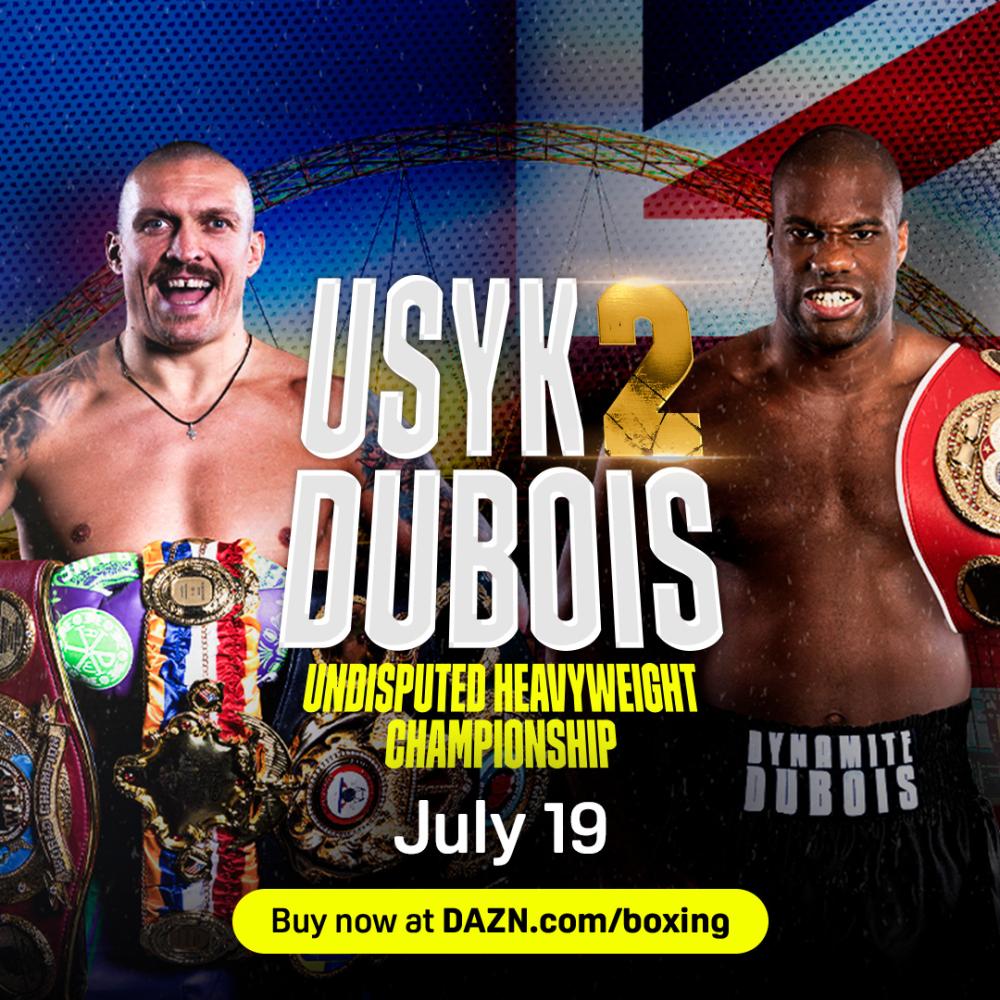
Usyk vs Dubois 2 only on DAZN
Watch Usyk versus Dubois 2 live and exclusive on DAZN PPV this Saturday - July 19 - for £24.99 UK; $59.99 US; $19.99/equivalent ROW. Buy the PPV now here.


